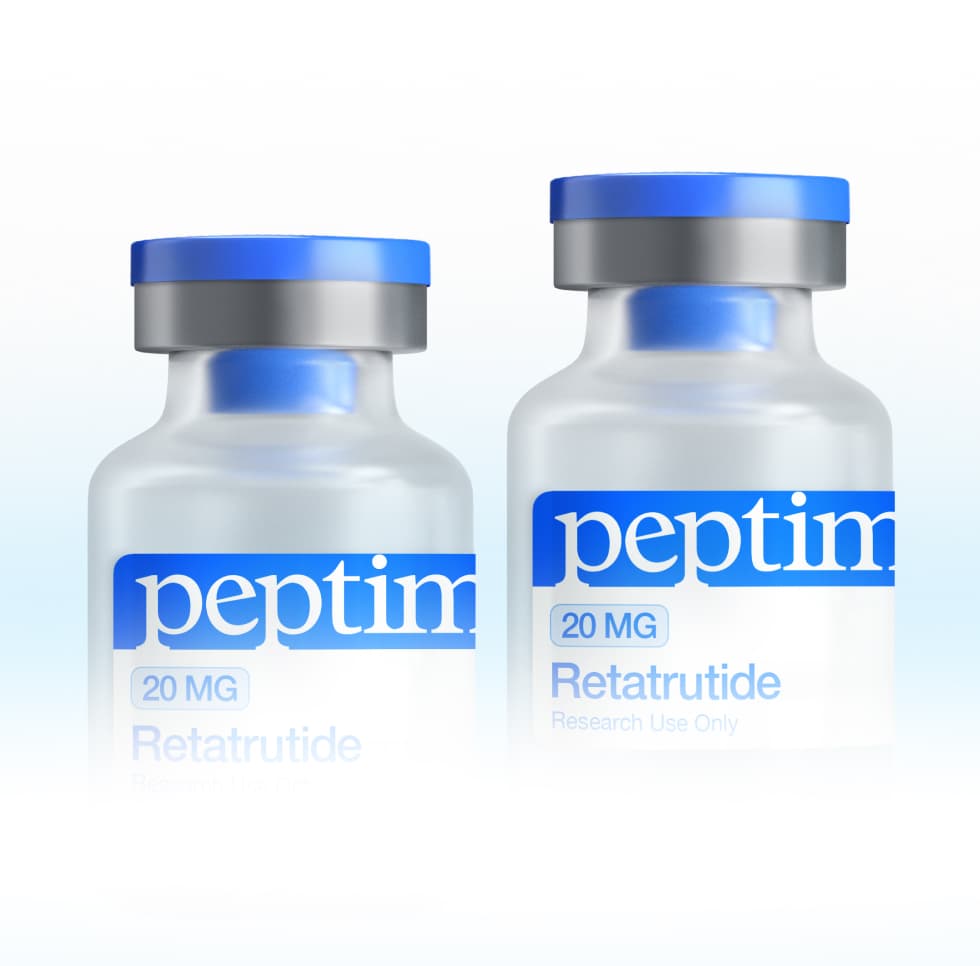
Retatrutide is an investigational triple-receptor agonist peptide being developed by Eli Lilly that simultaneously activates GLP-1, GIP, and glucagon receptors. This novel mechanism has delivered unprecedented weight-loss results in clinical trials: 24.2% body weight reduction at 48 weeks in the peer-reviewed Phase 2 trial (Jastreboff et al., NEJM 2023), and preliminary topline Phase 3 data from TRIUMPH-4 reporting 28.7% at 68 weeks in patients with obesity and knee osteoarthritis (pending full peer-reviewed publication) — making it one of the most potent obesity treatments ever studied. In March 2026, topline TRANSCEND-T2D-1 results confirmed retatrutide's efficacy in type 2 diabetes, with HbA1c reductions of up to -2.0% and weight loss of 16.8% at 40 weeks. Retatrutide's weight loss efficacy surpasses both semaglutide (~15%, STEP 1) and tirzepatide (~22.5%, SURMOUNT-1) in cross-trial comparisons, though direct head-to-head data are not yet available. Retatrutide has attracted significant attention among individuals seeking advanced metabolic support, those with obesity or type 2 diabetes, and biohackers exploring cutting-edge peptide therapies. Typical dosing protocols in clinical trials range from 1 mg to 12 mg administered once weekly via subcutaneous injection, with gradual dose escalation over 12 weeks to minimize side effects. Meaningful weight loss results typically emerge within 24 weeks, with continued improvements through 48 weeks and beyond. For a direct comparison with other leading GLP-1 class drugs, see semaglutide vs retatrutide and tirzepatide vs retatrutide.
What Is Retatrutide?
Retatrutide (LY3437943) is a 39-amino acid peptide built on a GIP peptide backbone, conjugated to a C20 fatty diacid moiety via a linker that enables albumin binding. It functions as a triple agonist, targeting three distinct G-protein-coupled receptors: glucose-dependent insulinotropic polypeptide (GIP), glucagon-like peptide-1 (GLP-1), and glucagon (GCG) receptors. Key amino acid modifications — including 2-aminoisobutyric acid (Aib) at positions 2 and 13, 2-methylleucine, and an L-serinamide at the C-terminus — confer resistance to DPP-4 degradation. This triple-receptor approach distinguishes retatrutide from existing therapies such as semaglutide (a single GLP-1 agonist) and tirzepatide (a dual GIP/GLP-1 agonist).
Retatrutide's receptor potency profile is GIP-primary: EC50 values are 0.0643 nM at the GIP receptor (most potent), 0.775 nM at GLP-1, and 5.79 nM at glucagon. Compared to endogenous ligands, this translates to approximately 8.9-fold greater potency at the human GIP receptor, with 0.4-fold and 0.3-fold relative potency at GLP-1 and glucagon receptors, respectively. The pharmacokinetics support once-weekly dosing, with a half-life of approximately 6 days and steady state reached in 4-5 weeks at each dose level.The primary human-use benefits observed in clinical research include:
- Substantial weight reduction (up to 24.2% in Phase 2 and 28.7% in preliminary Phase 3 data)
- Improved glycemic control and HbA1c reduction (up to -2.0% in Phase 3)
- Decreased waist circumference
- Improvements in liver fat levels (up to 82.4% reduction) and lipid profiles
How Retatrutide Compares
| Semaglutide (Wegovy) | Tirzepatide (Zepbound) | Retatrutide | |
|---|---|---|---|
| Mechanism | GLP-1 | GLP-1 + GIP | GLP-1 + GIP + Glucagon |
| Max Weight Loss | ~15.2% (STEP 1, 68 wk) | ~22.5% (SURMOUNT-1, 72 wk) | 24.2% (Phase 2, 48 wk) / 28.7% (Phase 3 topline, 68 wk) |
| Max Dose | 2.4 mg weekly | 15 mg weekly | 12 mg weekly |
| Half-Life | ~7 days | ~5 days | ~6 days |
| FDA Status | Approved (2021) | Approved (2023) | Investigational |
| Dosing | Once weekly | Once weekly | Once weekly |
Cross-trial comparisons have inherent limitations due to differences in study populations, trial design, and endpoints. For detailed head-to-head analysis, see semaglutide vs retatrutide and tirzepatide vs retatrutide.
How It Works
GLP-1 Receptor Activation
The GLP-1 receptor agonism component of retatrutide promotes weight loss through multiple pathways. GLP-1 receptor activation suppresses appetite, enhances satiety, and delays gastric emptying. Additionally, GLP-1 stimulation enhances glucose-dependent insulin secretion, directly improving glycemic control while reducing glucagon release between meals.
GIP Receptor Activation
Glucose-dependent insulinotropic polypeptide (GIP) receptor activation complements GLP-1 effects by further enhancing insulin secretion in response to nutrient intake. The synergistic combination of GIP and GLP-1 agonism has demonstrated superior efficacy compared with GLP-1 alone, as evidenced by tirzepatide's performance relative to semaglutide (see the semaglutide vs tirzepatide breakdown).
Glucagon Receptor Activation
The glucagon receptor agonism represents retatrutide's distinguishing feature. Glucagon receptor activation in obese patients increases energy expenditure through thermogenic effects, promotes hepatic lipid oxidation, and may enhance substrate utilization. However, the magnitude and consistency of this effect remain under investigation. Research also suggests glucagon agonism contributes to reductions in LDL cholesterol (approximately 20%) through effects on PCSK9 degradation.
Synergistic Triple-Receptor Effects
The simultaneous activation of all three receptors produces synergistic metabolic effects: appetite suppression, increased energy expenditure, improved glucose homeostasis, and enhanced fat oxidation. This multi-target approach addresses obesity through complementary mechanisms that single or dual agonists cannot achieve alone.
Secondary metabolic outcomes from clinical trials support the multi-system benefits of triple-receptor activation. Retatrutide 12 mg reduced triglycerides by 40.6%, non-HDL cholesterol by 26.9%, and apolipoprotein B (ApoB) by 24.2%. Among participants on antihypertensive medications, 41% of those on the 8 mg dose were able to discontinue blood pressure medications. Heart rate increased by approximately 6.7 bpm at the 12 mg dose, consistent with glucagon-mediated sympathetic activation.
“The inclusion of glucagon receptor agonism is pharmacologically bold — glucagon has historically been avoided in metabolic therapy due to its hyperglycemic effects, but retatrutide's concurrent GLP-1 and GIP activation effectively counterbalances this, allowing clinicians to harness glucagon's thermogenic and lipolytic benefits without compromising glycemic control.”

Dosage Protocols
Clinical trials employed structured dose-escalation protocols to manage gastrointestinal tolerability:
Starting dose: 0.5 mg weekly (the lowest dose used in Phase 2 dose-ranging)
Escalation schedule: Dose increases every 4 weeks, with slower escalation (6–8 weeks per step) recommended for those experiencing GI side effects. A conservative escalation path: 0.5 mg → 1 mg → 2 mg → 4 mg → 8 mg.
Maintenance doses studied:
- 1 mg weekly (low-dose arm in Phase 2, produced -8.7% body weight loss at 48 weeks)
- 4 mg weekly (moderate dose, Phase 2, produced -17.1% weight loss)
- 8 mg weekly (Phase 2)
- 9 mg weekly (Phase 3 TRIUMPH trials)
- 12 mg weekly (maximum studied dose)
Phase 3 titration protocol (TRIUMPH program): The standardized Phase 3 escalation follows 4-week steps: 2 mg → 4 mg → 6 mg → 8 mg → 10 mg → 12 mg, reaching the maximum dose by week 20. Steady state plasma concentrations are reached in 4-5 weeks at each dose level, supporting the 4-week step intervals.
Research indicates that even the 1 mg arm produced clinically meaningful weight loss (-8.7% at 48 weeks), and starting at the lowest available dose with gradual escalation significantly mitigates gastrointestinal adverse events. Higher doses should only be pursued if lower doses prove insufficient after adequate trial periods.
No FDA-approved dosing guidelines exist for retatrutide as of 2026. All protocols referenced are derived from clinical trial data.
Research reconstitution: For research preparations, reconstitution conventions vary. Adding 2 mL of bacteriostatic water to a 10 mg vial yields 5 mg/mL (suitable for smaller injection volumes), while 10 mL yields 1 mg/mL (easier dose calculation). Neither is derived from official guidelines, as no commercial formulation exists.
How to Use / Administration
Retatrutide is administered via subcutaneous injection once weekly. In clinical trials, participants self-administered injections following standard subcutaneous injection protocols.
Injection sites: Common subcutaneous injection sites include the abdomen (avoiding the navel area), front of thighs, or upper arms. Rotation of injection sites is recommended to prevent lipodystrophy.
Timing: Retatrutide can be administered at any time of day, with or without meals. Consistency in weekly timing is recommended.
Injection technique: Standard subcutaneous injection protocols apply: clean the injection site with alcohol, pinch the skin, insert the needle at a 45 to 90 degree angle, inject slowly, and apply gentle pressure after withdrawal.
Results Timelines
Week 24 (6 months):
- 12 mg dose: -17.5% body weight
- 8 mg dose: -17.3% body weight
- 4 mg dose: -12.9% body weight
Week 48 (12 months):
- 12 mg dose: -24.2% body weight
- 8 mg dose: -22.8% body weight
- 4 mg dose: -17.1% body weight
Notably, weight loss curves had not plateaued at 48 weeks, suggesting continued benefits with longer treatment duration. Preliminary topline Phase 3 data from TRIUMPH-4 at 68 weeks reported up to 28.7% weight loss with the 12 mg dose in patients with obesity and knee osteoarthritis (not a general obesity population); these results are pending full peer-reviewed publication.
Achievement thresholds at 48 weeks (12 mg dose):
- ≥5% weight loss: 100% of participants
- ≥10% weight loss: 93% of participants
- ≥15% weight loss: 83% of participants
- ≥20% weight loss: 63% of participants
- ≥25% weight loss: 48% of participants
- ≥30% weight loss: 26% of participants
Research Evidence
“The fact that weight loss curves had not plateaued at 48 weeks is clinically significant — it suggests retatrutide's metabolic effects, particularly glucagon-driven energy expenditure, sustain efficacy beyond the point where most GLP-1 monotherapies begin to level off.”
The clinical evidence base for retatrutide continues to expand through multiple trials:
Phase 2 Obesity Trial (NEJM, 2023): This randomized, double-blind, placebo-controlled trial enrolled 338 adults with obesity. The 12 mg dose produced 24.2% weight loss at 48 weeks, with 100% of participants achieving ≥5% weight reduction.
Phase 2 Type 2 Diabetes Trial (Lancet, 2023): In adults with type 2 diabetes, retatrutide demonstrated clinically meaningful improvements in glycemic control alongside robust weight reductions.
Phase 3 TRIUMPH-4 Trial (December 2025, topline data): Preliminary topline results from TRIUMPH-4, conducted in 445 patients with obesity and knee osteoarthritis, reported that participants taking retatrutide 12 mg lost an average of 28.7% body weight (71.2 lbs) at 68 weeks. At the 12 mg dose, 58% of participants achieved ≥25% weight loss, 30-39% achieved ≥30%, and 23.7% achieved ≥35% weight loss. Beyond weight loss, the trial demonstrated significant improvements in joint outcomes: WOMAC pain scores improved by approximately 4.5 points from a baseline of 6 (a 76% improvement), and 12.5% of retatrutide-treated participants achieved complete zero pain compared with 4.2% on placebo. Physical function scores also improved significantly. These are preliminary results pending full peer-reviewed publication.
Phase 3 TRANSCEND-T2D-1 Trial (March 2026, topline data): In 537 adults with inadequately controlled type 2 diabetes (HbA1c 7.0-9.5%), retatrutide produced HbA1c reductions of -1.7% to -2.0% (vs -0.8% placebo) and weight loss of 11.5% to 16.8% over 40 weeks. The 12 mg dose produced average weight loss of 36.6 lbs (16.8% body weight). Notably, weight loss had not plateaued at 40 weeks, consistent with the Phase 2 obesity findings. Full results are expected to be presented at the ADA Scientific Sessions in June 2026.
Phase 2 MASLD Substudy (Nature Medicine, 2024): In a substudy of 98 participants with metabolic dysfunction-associated steatotic liver disease (MASLD), retatrutide 12 mg reduced liver fat by 82.4% compared with a 0.3% increase in the placebo group at 48 weeks. Between 82% and 93% of treated participants achieved normal liver fat levels (<5%). These results are the most dramatic liver fat reductions reported for any incretin-class therapy and have led to the SYNERGY-Outcomes Phase 3 trial (approximately 4,500 patients).
Body Composition Analysis (Lancet Diabetes & Endocrinology, 2025): In adults with type 2 diabetes, retatrutide reduced total body fat mass by up to 26.1% compared with placebo and dulaglutide. However, lean mass loss remained a concern: up to 6.5 kg of lean mass was lost, representing approximately 40% of total weight loss. Current evidence suggests that protein intake of 1.6 to 2.2 g/kg/day combined with resistance training can reduce lean mass loss to 15-20% of total weight lost.
Anti-Cancer Preclinical Data (npj Metabolic Health and Disease, 2025): In preclinical models, retatrutide reduced pancreatic tumor volume by 14-fold compared with controls (semaglutide achieved only a 4-fold reduction) and lung adenocarcinoma volume by 17-fold. Anti-tumor effects persisted even after drug withdrawal and subsequent weight regain. The mechanism involves enhanced CD8+ T cell infiltration and reduced immunosuppressive cells. These are early-stage findings in animal models and cannot be extrapolated to human cancer treatment, but they suggest that triple-receptor agonism may have anti-proliferative properties beyond what single GLP-1 agonists provide.
Meta-Analysis (2024): A systematic review confirmed retatrutide demonstrated significant improvements in body weight and metabolic outcomes with an appropriate safety profile.
Stacking
Currently, there is limited published research on combining retatrutide with other peptides or compounds. Given its comprehensive triple-receptor mechanism, retatrutide functions as a standalone therapy that simultaneously addresses multiple metabolic pathways.
Theoretical considerations for researchers:
With other GLP-1 agonists: Not recommended due to overlapping mechanisms and increased risk of gastrointestinal adverse events.
With metformin: Clinical trials included participants on stable metformin therapy; the combination appeared well-tolerated.
With lifestyle interventions: The clinical trials incorporated dietary counseling and physical activity guidance, which should be considered complementary rather than optional.
Reconstitution, Storage & Prep
Lyophilized (powder) form storage:
- Store at -20°C for long-term preservation
- Protect from light
- Stable at 2-8°C (refrigerator) for shorter periods
Reconstitution protocol:
- Allow the vial to reach room temperature
- Draw bacteriostatic water using a sterile syringe (typically 2 mL for a 10 mg vial)
- Inject the diluent slowly down the vial wall to avoid foaming
- Gently swirl or roll the vial until the powder fully dissolves; do not shake vigorously
- Inspect for complete dissolution and absence of particulates
Reconstituted solution storage:
- Store at 2-8°C (refrigerator)
- Use within 28-30 days of reconstitution
- Protect from light
- Do not freeze the reconstituted solution
Side Effects
The safety profile of retatrutide is consistent with other incretin-based therapies, with gastrointestinal events being most common:
Common side effects (dose-dependent):
- Nausea (14 to 45% depending on dose)
- Diarrhea (9 to 20%)
- Vomiting (3 to 26%)
- Constipation (7 to 16%)
- Decreased appetite (13 to 31%)
- Fatigue (4 to 12%)
Less common effects:
- Injection site reactions
- Mild increases in heart rate (approximately 6.7 bpm at 12 mg, dose-dependent, peaking at 24 weeks, then declining)
- Dysesthesia / cutaneous hyperesthesia (altered skin sensation): 20.9% at 12 mg vs 0.7% placebo in TRIUMPH-4 Phase 3, typically mild, and did not appear in Phase 2 trials — it emerged only in larger Phase 3 studies. The probable mechanism is glucagon receptor activation in cutaneous sensory neurons, which is unique to retatrutide among incretin-class drugs.
- Transient increases in lipase levels
Serious but rare:
- Acute pancreatitis (1 case in phase 2 trial)
- Hypersensitivity reactions
- Biliary disorders (cholelithiasis, cholecystitis)
“The GI side effect profile mirrors what we see across the incretin class, but the dose-dependent nausea rates reaching 45% at higher doses underscore why structured dose escalation is non-negotiable — starting low and titrating slowly is the single most effective strategy for improving patient tolerability and adherence.”
“Dysesthesia is the safety signal to watch as retatrutide advances through Phase 3. At 20.9% incidence it is not rare, but the vast majority of cases are mild and self-limiting. The key question is whether dose titration strategies or lower maintenance doses can mitigate it without sacrificing efficacy — this will be a central consideration for the NDA submission.”
Legal Status / FDA
Retatrutide is not currently approved by the FDA or any regulatory agency worldwide. It remains an investigational medication undergoing clinical development by Eli Lilly.
Current development status — 19 clinical trials across three program families (TRIUMPH for obesity, TRANSCEND for type 2 diabetes, and SYNERGY for liver disease), enrolling approximately 19,707 participants total:
- TRIUMPH-4 (obesity + knee OA): completed December 2025
- TRANSCEND-T2D-1 (type 2 diabetes): completed March 2026
- TRIUMPH-1 (general obesity) results expected: Q2 2026
- TRIUMPH-2 (obesity + type 2 diabetes) results expected: Q3 2026
- TRIUMPH-3 (cardiovascular outcomes) results expected: Q4 2026
- TRIUMPH-Outcomes (CVOT): ~10,000 patients, 5-year study, ongoing
- SYNERGY-Outcomes (MASLD/liver): ~4,500 patients, ongoing
- TRANSCEND-CKD (chronic kidney disease): ongoing
- TRIUMPH-6 (adolescent obesity, ages 12-17): ongoing, EMA pediatric investigation plan approved September 2024
- NDA submission projected: Q4 2026 to Q1 2027
- PDUFA target action date: September to October 2027
- Most likely FDA approval: late 2027 or early 2028
Research-grade retatrutide is available through peptide suppliers for research purposes. However, these products are not intended for human use and are sold strictly for laboratory research. For guidance on sourcing and quality verification, see the guides on peptide legality and how to safely source peptides.
Sports / WADA
Retatrutide is not explicitly named on the World Anti-Doping Agency (WADA) Prohibited List as of 2026. However, athletes should exercise extreme caution:
- GLP-1 receptor agonists (including semaglutide) have been on WADA's monitoring list since 2024
- Retatrutide could potentially fall under prohibited categories related to metabolic modulators or peptide hormones
- WADA reserves the right to prohibit substances that enhance performance or pose health risks
- Athletes subject to anti-doping testing should consult with their sports organization before using any investigational compound
Conclusion
Retatrutide represents a significant advancement in peptide-based metabolic therapy, with a novel triple-receptor mechanism that addresses obesity and metabolic dysfunction through complementary pathways. Clinical trial data demonstrating 24.2% weight loss in the peer-reviewed Phase 2 trial, with preliminary Phase 3 topline data reporting up to 28.7%, positions retatrutide as potentially the most effective pharmacological obesity treatment studied to date. While awaiting regulatory approval, the compound has generated substantial interest among researchers and individuals seeking advanced metabolic support. As with any investigational compound, a thorough understanding of dosing protocols, administration techniques, potential side effects, and legal considerations is essential for informed decision-making.